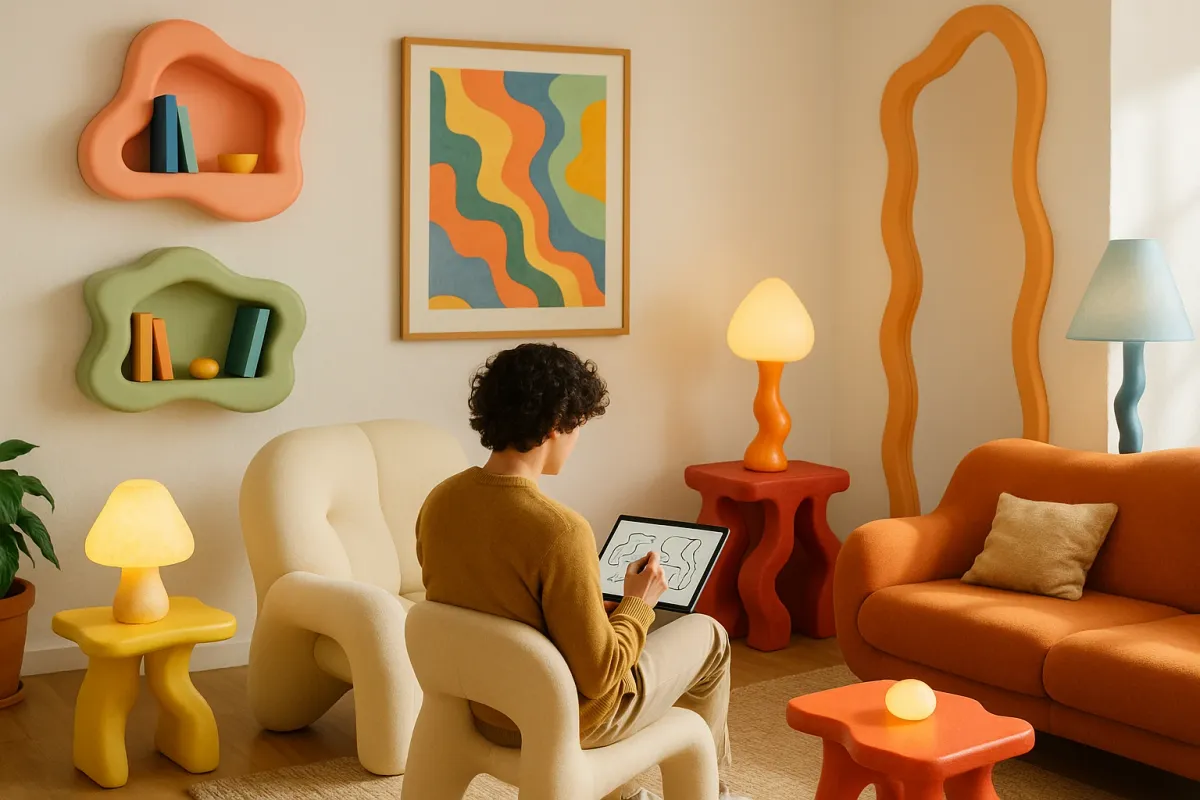
The good news: you don’t need a celebrity architect or a massive budget to add that same fun, slightly-weird charm at home. You can borrow the spirit of those viral buildings—bold shapes, unexpected textures, and quirky details—and turn it into small, doable DIY projects that fit into a weekend.
Below are five step‑by‑step, beginner‑friendly ways to bring a bit of that “is this real or AI?” vibe into your own space.
1. Create A “Statement Shape” Wall Without Remodeling
Those viral buildings stand out because of one big, confident shape—a giant circle window, a wavy roofline, or a loaf-of-bread façade. You can borrow that idea with paint and a level, no drywall work needed.
You’ll need:
- Painter’s tape
- Level or laser level (optional but helpful)
- Pencil and string (for circles)
- Sample or quart of paint in a bold color
- Small roller and angled brush
Steps:
- Choose your shape. Circle behind the TV, arch behind the bed, diagonal block of color in a corner—pick one clean, simple shape.
- Lightly map it out.
- For a circle: tie a string to a pencil, hold the other end at the circle’s “center,” and trace.
- For an arch: use something round (laundry basket, big bowl) to trace the curve, then use a level to draw straight sides.
- Tape your edges. Use painter’s tape along your pencil lines. Press the tape down firmly with your fingernail for crisp lines.
- Seal the tape (pro tip). Paint over the tape edge with your wall’s existing color first. Let it dry; this “locks” the tape and helps prevent bleed-through.
- Add your bold color. Use a small roller for large areas and an angled brush for edges. Two coats usually do it.
- Peel while slightly wet. Carefully remove tape before the final coat fully dries to avoid peeling.
This single shape instantly gives your room some of that architectural drama you see in those wild buildings—without touching a single 2x4.
2. Build A Tiny “Faux Façade” Shelf That Looks Like A Mini Building
Odd, character-filled exteriors go viral because they look like characters themselves—a building with a face, a loaf, or a cartoonish outline. You can mimic that on a small scale by turning a plain wall shelf into a playful “mini building façade.”
You’ll need:
- A basic wood shelf (IKEA-style is perfect)
- Thin craft wood or foam board
- Craft knife or hand saw
- Wood glue or strong craft glue
- Paint + small brushes
- Ruler and pencil
Steps:
- Assemble your shelf. Build or hang your basic shelf according to the instructions.
- Design your “front.” On paper, sketch a simple building outline: maybe a rounded top, a peaked “roof,” or a zigzag edge like a cartoon skyline.
- Transfer to wood or foam board. Measure the front of your shelf and draw your design to match that width.
- Cut the silhouette. Use a craft knife (for foam) or hand saw (for thin wood). Sand any rough edges on wood.
- Add details. Lightly draw “windows” and “doors” on the façade. These can be just painted rectangles; no carpentry needed.
- Paint it.
- Base color for the “building”
- Contrasting color for windows and trim
- You can go whimsical: pastel pink building, yellow windows, blue door.
- Attach to the shelf. Glue the façade to the front lip or slightly above the shelf so it looks like a mini building sitting on your wall.
Now your storage doubles as art—exactly the kind of functional-but-fun design that gets those real-world weird buildings shared all over social media.
3. Add “Unexpected Texture” Like The Wild Exteriors You See Online
Many of the odd buildings in that viral roundup stand out because of their surfaces: scales, bumps, tiles, or ribbed patterns you don’t usually see on everyday houses. You can recreate that with removable, renter-friendly texture.
You’ll need:
- Peel-and-stick 3D wall panels or textured wallpaper
- Utility knife
- Straight edge
- Tape measure
- Clean cloth and mild cleaner
Steps:
- Pick your spot. Great options: behind your desk, in a hallway, or as a vertical strip next to a doorway.
- Measure carefully. Measure the height and width; write these down before you cut anything.
- Prep the wall. Wipe it down with a damp cloth and mild cleaner. Let it dry completely.
- Cut panels to size. Use a straight edge and utility knife. Cut from the backside if there’s a pattern.
- Test layout on the floor. Lay pieces out as they’ll appear on the wall to check alignment and pattern.
- Peel and stick from one edge. Start at the top, peeling just a bit of backing at a time. Smooth with your hand as you go to avoid bubbles.
- Blend the seam. Slightly overlap or butt edges tightly depending on the product instructions. Use your fingers to press all seams firmly.
You’ve now added a “why does that wall look so interesting?” moment to your home—the same reaction people have when they scroll past those hyper-textured buildings.
4. Turn A Door Into A “Portal” With A Bold Outline
Many of the buildings in that Bored Panda piece look unreal because they lean hard into outlines: thick trims, unusually colored borders, exaggerated door shapes. You can echo that effect with paint and a steady hand.
You’ll need:
- Painter’s tape
- A quart of high-contrast paint (dark on light walls or vice versa)
- Small angled brush
- Ruler and pencil
Steps:
- Choose your door. A bathroom door, closet door, or pantry is perfect for this.
- Decide your outline width. 1–3 inches works well. Lightly mark that width around the door frame with a pencil.
- Tape your border. Place tape along your pencil marks to create a clean “frame” around the door. Tape the inside and outside edges so you’re painting only the border line.
- Cut in carefully. Using a small angled brush, paint within the taped border. Two coats will make the color pop.
- Optional: add a “fake arch” or shape. Use a bowl or string method to draw an arch above a rectangular door and paint that shape too, even if the door itself is still square.
- Remove tape and clean edges. Peel gently while paint is still slightly tacky. Touch up any tiny bleeds with your wall color.
The result feels like you turned a regular door into a “portal”—dramatic, a little cartoony, and completely on‑trend with all those surreal architectural designs people are sharing right now.
5. Build A Quirky “Micro Landmark” For Your Yard Or Balcony
Those odd buildings go viral partly because they become landmarks—people snap photos, share them, and talk about them. You can create your own tiny landmark at home: a small structure that’s more playful than practical, but brings you joy every time you see it.
You’ll need:
- A few concrete pavers or bricks or scrap wood
- Exterior paint
- Paint sealer (if needed)
- Brushes
- Optional: solar path light
Steps:
- Choose the scale. This can be as small as a mailbox-sized “tower” or a knee-high stack of painted blocks on a balcony.
- Create a simple shape.
- Stack pavers or bricks into a short column.
- Or build a basic wooden box or triangle from scrap wood.
- Stabilize it. Make sure your stack or structure won’t wobble. Use outdoor construction adhesive between brick layers if you want it more permanent.
- Prime if necessary. If your surface is very smooth or glossy, give it a quick prime with an outdoor primer.
- Paint like it’s a cartoon building.
- Base color for the “structure” (think mint green, terracotta, cobalt blue).
- Add simple windows, lines, or even funny “eyes” to make it feel like a character.
- Seal the paint. Use a suitable outdoor sealer to protect your design from weather.
- Optional: add light. Stick a small solar light on top to make it glow at night—instant neighborhood conversation starter.
This doesn’t need to be perfect. The charm of many of those internet-famous buildings is that they look a bit too bold, too playful—and that’s exactly the energy you’re bringing home.
Conclusion
The real-life “bread-shaped bread factory” and other weird, wonderful buildings going viral right now prove one thing: people are hungry for creativity in the places we live and work. You don’t need a construction crew or an architecture degree to tap into that trend. A shape on a wall, a mini building shelf, a textured accent, a bold door outline, or a tiny yard landmark can all shift your home from “generic” to “that’s so you.”
Start with one small project that excites you. It doesn’t have to be perfect; it just has to be yours. The more you experiment, the more your home will feel like a space that could easily show up in someone’s “wow, look at this place” feed—only this time, you’re the designer.