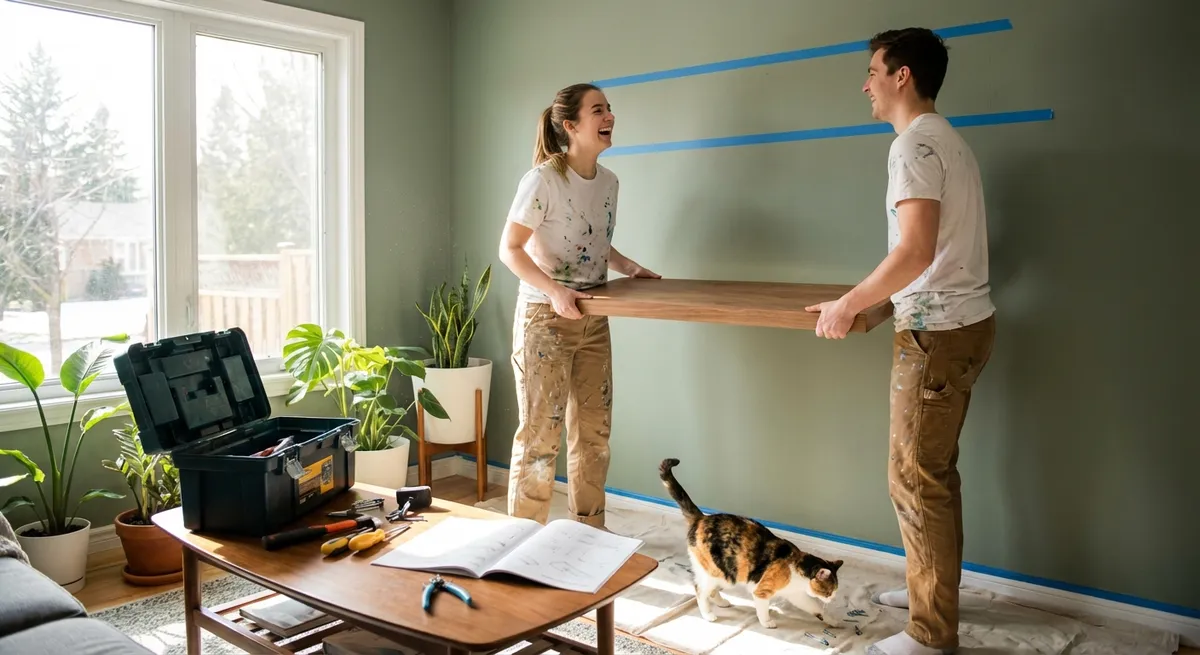
This guide walks you through five beginner-friendly home projects with clear, step-by-step instructions. No fancy skills required, just a willingness to try and a bit of patience.
Tip 1: Create a Simple Entryway Landing Zone
Even if you don’t have a formal entryway, you can build a “landing zone” to catch keys, bags, and mail so clutter stops exploding across the whole house.
What you’ll need:
- Small tray, shallow basket, or dish (for keys/wallet)
- Hooks (adhesive or screw-in)
- Small bin/basket (for mail or random items)
- Tape measure or ruler
- Pencil
Step-by-step:
- Pick your spot. Choose the place you naturally drop things when you walk in—near the front door, kitchen counter, or hallway wall.
- Define “parking spaces.” Decide where keys, mail, and bags will live. Example: keys in a tray, mail in a basket, bag on a hook.
- Hang hooks at the right height.
- Measure about 48–60 inches from the floor (lower for kids).
- Lightly mark with a pencil.
- Use adhesive hooks if you’re renting or nervous about drilling.
- Add the tray or dish. Place a tray on a console, shelf, or even a windowsill near the door. This is your “no excuses” spot for keys and wallets.
- Assign the mail bin. Put a small bin or vertical file on a shelf or counter. All paper goes there first—no random piles.
- Test for a week. Each time you walk in, use the system on purpose. Adjust hook height or container size if it feels awkward.
Why this works: You’re not just organizing; you’re creating an easy habit. The simpler and closer to the door it is, the more likely everyone will actually use it.
Tip 2: Upgrade Lighting With Plug-In Lamps and Smart Bulbs
Lighting might be the fastest way to make your home feel calmer, warmer, and more intentional—without touching a single wire.
What you’ll need:
- 1–2 plug-in lamps or plug-in wall sconces
- LED bulbs (soft white or warm white for living spaces)
- Optional: smart bulbs or smart plugs
- Power strip if outlets are limited
Step-by-step:
- Walk your space at night. Turn off overhead lights and see where it feels too dark or harsh. Corners? Hallway? Sofa area?
- Choose your light type.
- Table or floor lamps for living rooms and bedrooms
- Plug-in sconces if you want a “built-in” look without wiring
- Pick your bulbs.
- Look for 2700K–3000K (soft/warm white) for cozy rooms.
- Choose higher lumens (brightness) for work areas like desks.
- Place lamps with intention. Put at least one light at eye level when you’re sitting. Aim lamps into corners or onto walls to bounce soft light around the room.
- Add a smart control (optional).
- Screw in a smart bulb or plug the lamp into a smart plug.
- Use the app to set timers or create a “wind down” schedule in the evening.
- Test a two-layer setup. Use overhead lighting for cleaning or projects, and lamps for relaxing. Practice switching between them based on what you’re doing.
Why this works: You’re not just “adding light”—you’re zoning your space. This makes rooms feel intentional and more comfortable for both work and rest.
Tip 3: Build a No-Drill Gallery Wall With Command Strips
Blank walls can make a home feel unfinished, but drilling can feel intimidating. A no-drill gallery wall lets you practice layout and style with almost zero risk.
What you’ll need:
- 4–8 light frames or art pieces (mix of sizes)
- Painter’s tape or scrap paper
- Scissors
- Measuring tape
- Level (or level app on your phone)
- Adhesive picture-hanging strips (e.g., Command Strips)
Step-by-step:
- Gather your art. Mix personal photos, prints, kids’ art, postcards, or fabric scraps in frames. They don’t need to match perfectly—just share a color or vibe.
- Lay it out on the floor.
- Start with the biggest piece in the center.
- Arrange smaller ones around it, leaving 1–3 inches between frames.
- Snap a quick photo when it looks balanced.
- Create paper templates (optional but helpful).
- Trace each frame onto paper or use wrapping paper.
- Cut out and tape these “fake frames” to the wall.
- Hang at the right height.
- The center of your arrangement should be about 57–60 inches from the floor (roughly eye level).
- Adjust templates until it feels right.
- Attach adhesive strips to frames. Follow the package directions: usually, stick strips to frame, then to wall, pressing firmly for 30 seconds.
- Hang using your floor photo. Replicate the layout you liked on the floor, using your photo as a guide.
- Step back and tweak. Small adjustments are simple—adhesive strips come off cleanly if you follow instructions.
Why this works: You’re decorating in a reversible way. If you change your mind later, you’re not left patching holes or repainting.
Tip 4: Tame a Single Drawer With Simple Dividers
Instead of “organize the whole kitchen,” zoom in: transform one disaster drawer into a smooth, easy-to-use space. This builds real momentum.
What you’ll need:
- One messy drawer (kitchen, bathroom, desk)
- Drawer organizer or small boxes/containers
- Tape measure
- Trash/recycle bin and a donation bag
Step-by-step:
- Pick just one drawer. Not the whole room—only one. Choose the one that annoys you daily (junk drawer, utensil drawer, makeup drawer).
- Empty it completely. Place everything on a counter or table. Wipe the drawer clean with a damp cloth and let it dry.
- Sort by rough categories.
- Example: pens, tools, batteries, receipts, random hardware.
- Toss obvious trash, duplicate items, and broken things.
- Measure the drawer. Note width, depth, and height so organizers actually fit.
- Add organizers or boxes.
- Use purpose-built drawer organizers or repurpose small boxes (phone boxes, food containers, small tins).
- Assign each category its own “home.”
- Put back only what earns a space. If you can’t easily assign it a category and space, it probably doesn’t belong in that drawer.
- Label if needed. A strip of masking tape and a pen is enough. Labels help other people follow your system.
Why this works: You’re proving to yourself that you can complete a project start-to-finish. One handled drawer feels small—but it changes how you use that space every day.
Tip 5: Seal a Drafty Window With Removable Insulation
If your home feels chilly near windows (or your energy bill is high), a simple DIY window-sealing project can make the room more comfortable without permanent changes.
What you’ll need:
- Window insulation kit (shrink film + tape), OR
- Removable weatherstripping or foam tape
- Scissors
- Hair dryer (if using shrink film)
- Mild cleaner and cloth
Step-by-step (for shrink-film kits):
- Pick one problem window. Stand near windows on a cold or windy day and feel for drafts around the edges or glass.
- Clean the frame. Wipe the window frame where you’ll apply tape. Let it dry fully so the adhesive sticks.
- Apply the double-sided tape.
- Stick the tape around the window frame according to the kit directions.
- Press firmly to ensure good adhesion.
- Cut the plastic film to size. Leave a small overlap beyond the tape line on all sides.
- Stick the film to the tape. Start at the top, then sides, then bottom, pulling it gently taut but not stretched.
- Shrink with the hair dryer.
- Use medium heat.
- Move the dryer back and forth over the film until it tightens and wrinkles disappear.
- Check for drafts again. You should feel a noticeable reduction in cold air.
Alternative (no plastic look): Use removable weatherstripping or foam tape around the sides of the window sash to close small gaps while still being able to open the window later.
Why this works: This is a low-commitment intro to energy-efficiency DIY. It’s reversible, budget-friendly, and results are easy to feel right away.
Conclusion
You don’t have to overhaul your whole home to feel proud of your space. Small, focused projects—like setting up an entryway landing zone, layering better lighting, creating a no-drill gallery wall, calming a chaotic drawer, or sealing a drafty window—build both comfort and confidence.
Pick one of these tips and schedule 30–60 minutes to try it. Once you see what you can accomplish in a short, doable session, the next project won’t feel nearly as intimidating. DIY isn’t about perfection; it’s about learning, adjusting, and enjoying your home a little more every time you try something new.
Sources
- U.S. Department of Energy – Energy Saver: Windows, Doors and Skylights - Explains how windows affect home comfort and energy use, and why sealing drafts matters
- Energy Star – Heat and Cool Efficiently - Provides guidance on improving home comfort with efficient heating, cooling, and insulation choices
- The Spruce – How to Hang a Gallery Wall - Offers layout ideas and hanging tips that complement the no-drill gallery wall approach
- Command Brand (3M) – How to Use Picture Hanging Strips - Official instructions for safely hanging frames without nails
- Mayo Clinic – Light Therapy: Benefits and Uses - Describes how light affects mood and daily rhythms, supporting the importance of thoughtful home lighting