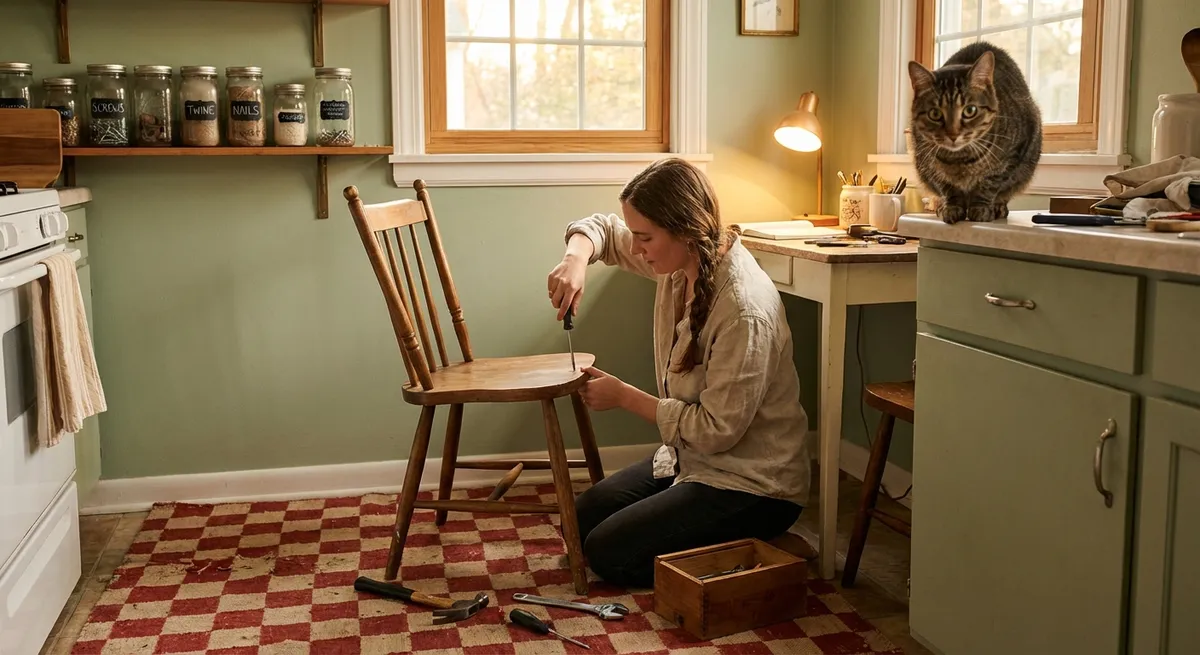
Each tip is broken into easy steps so you can follow along at your own pace, with what you already have on hand.
Tip 1: Stop a Dripping Faucet with Simple Checks
A dripping faucet is more than an annoyance—it wastes water and money. The good news: many drips are caused by worn-out parts you can replace yourself.
What you’ll need (for most faucets):
Adjustable wrench, screwdriver, replacement washer or cartridge (bring the old one to the store to match), towel.
Step-by-step:
- Turn off the water supply.
Look under the sink for two small valves (hot and cold). Turn them clockwise until they stop. Turn the faucet on to make sure the water is off.
- Plug the drain.
Use the sink stopper or a rag so small screws or parts don’t disappear down the drain.
- Remove the handle.
Most handles have a small cap (hot/cold indicator) hiding a screw. Pry it off gently with a flat screwdriver or your fingernail, then unscrew the handle and lift it off.
- Access the cartridge or washer.
Under the handle, you’ll see a nut or retaining clip. Use your wrench or screwdriver to remove it. Carefully pull out the cartridge or stem.
- Inspect the rubber parts.
Look for cracked, flattened, or brittle rubber washers or O-rings. These are usually the drip culprits. Remove them gently.
- Take old parts to the store.
Match them exactly at a hardware store—same size, shape, and type. Staff can usually help you find the right kit.
- Reassemble in reverse order.
Install the new washer/O-ring or cartridge, tighten the nut (snug, but not overly tight), replace the handle and screw, then pop the cap back on.
- Turn water back on slowly.
Open the valves under the sink gradually and check for leaks. Run the faucet for a minute to clear any trapped air.
If it still drips, the faucet body may be damaged, but often this simple repair solves it. Either way, you’ve learned how the inside of a faucet works—huge win.
Tip 2: Hang a Picture Straight Without Special Tools
Crooked pictures drive people nuts, but precision doesn’t require a laser level. With a few basic tricks, you can hang frames neatly and securely.
What you’ll need:
Hammer, appropriate wall hooks or screws, tape measure, pencil, masking tape, and optionally a smartphone with a level app.
Step-by-step:
- Choose the right hardware.
- For drywall and light frames (under ~10 lb): picture hanging hooks work well.
- For heavier items: use wall anchors or go into a stud with a screw.
- Decide on height.
A common rule: center of artwork at about 57–60 inches from the floor (eye level). Mark that general area lightly with a pencil.
- Mark the frame’s hanging point.
Flip the frame over and look for:
- A wire: pull it up tight as if hanging and measure from the wire’s highest point to the top of the frame.
- Sawtooth hanger or D-rings: measure from the hanger to the top of the frame.
- Transfer measurement to the wall.
From your eye-level mark on the wall, measure up or down based on your measurement from Step 3, and mark where the nail or hook should go.
- Use masking tape for precise width.
For frames with two hooks: place masking tape across the back, marking where each hook or D-ring sits. Peel the tape off and stick it on the wall at your desired height. You now know exactly where to put each nail.
- Check “level” with your phone.
Many smartphones have a built-in level in their measure tools. Place the phone on top of the frame and adjust until it reads level. If not available, eyeballing against door frames and ceilings works surprisingly well.
- Hang and adjust.
Hang the frame on the nail(s), then step back a few feet. Tiny shifts left or right often make a big visual difference.
Once you’ve done this once or twice, hanging a gallery wall or rearranging art becomes a quick, no-stress task.
Tip 3: Fix a Wobbly Chair or Table So It Feels Solid Again
That one wobbly chair everyone avoids at the table? You can usually fix it in under an hour with glue and patience.
What you’ll need:
Wood glue, clamps (or straps/ropes as makeshift clamps), damp cloth, screwdriver or Allen key, sandpaper (optional).
Step-by-step:
- Flip and inspect.
Turn the chair/table upside down. Gently wiggle each leg to see where it’s loose. Look for gaps where wood meets wood or screws that have backed out.
- Tighten fasteners first.
Use a screwdriver or Allen key to tighten any visible screws or bolts. Sometimes that alone solves the wobble.
- Disassemble loose joints.
If glue joints are loose (wood tenons or dowels slipping out), gently pull the leg or rail apart as far as it will reasonably go without forcing. You want room for glue to get inside.
- Apply wood glue to the joint.
Squeeze wood glue into the gap and onto any dowels or tenons. Use a small brush, scrap of cardboard, or toothpick to spread it evenly.
- Reassemble and clamp.
Push the joint back together firmly. Wipe excess glue with a damp cloth. Then clamp it tightly so pieces stay in place while the glue cures. If you don’t have clamps, use ratchet straps, belts, or rope wrapped tightly around the legs to pull them together.
- Check for square.
While clamped, sight down the legs to make sure they’re straight and not twisted. Adjust slightly before the glue sets if needed.
- Let it cure fully.
Most wood glues need at least 30–60 minutes before moving, and 24 hours for full strength. Resist the urge to sit on or move the furniture too soon.
- Test and touch up.
After curing, remove clamps and test for wobble. If needed, sand any dried glue drips and touch up with wood marker or finish.
The next time someone starts to sit in the “bad” chair and hesitates, you’ll know it’s solid because you fixed it yourself.
Tip 4: Create a Simple, Safe Emergency Tool Kit from What You Have
You don’t need a huge toolbox to handle most everyday jobs. A compact, well-chosen kit lets you handle small problems before they become big ones.
Goal: Build a starter toolkit that fits in a small bin or bag and covers most home basics.
Core items to include:
- Screwdriver with interchangeable bits.
One handle with multiple bits (Phillips, flathead, maybe Torx) saves space and tackles most screws around the home.
- Adjustable wrench.
Handles faucets, nuts, and many small plumbing or assembly tasks without needing a full wrench set.
- Measuring tape.
At least 16 feet. Essential for hanging shelves, ordering furniture, or checking if something will fit through a doorway.
- Utility knife and spare blades.
For opening boxes, trimming materials, and general cutting. Always retract the blade when not in use.
- Pliers (ideally needle-nose).
Great for gripping, bending wire, pulling small nails, and reaching into tight spaces.
- Small level.
For straight shelves, pictures, and appliances. A compact 9–12 inch level is enough for most jobs.
- Assorted fasteners.
Keep a small organizer with: nails, wood screws, wall anchors, picture hooks, and a few zip ties.
- Safety basics.
Work gloves, safety glasses, and a small flashlight or headlamp so you can see into dark corners safely.
Step-by-step to assemble:
- Check what you already own.
Collect scattered tools from drawers, closets, and “junk” spots. You may have more than you think.
- Fill the gaps strategically.
Use a simple list (like the one above) and buy only what’s missing. Choose quality basics over fancy specialty tools.
- Choose a container.
A sturdy shoebox, plastic bin, or small tool bag works. The best toolkit is the one you can actually find when you need it.
- Label and store.
Label the container “Tools – Do Not Move” and keep it in a consistent, easy-to-reach place like a hall closet or utility area.
- Add notes or manuals.
Toss in a small notebook or envelope with key appliance manuals, measurements of your rooms, and any sizes you often need (filter size, light bulbs, etc.).
Over time, you can upgrade or add items, but even this small kit puts you ahead of a lot of everyday frustrations.
Tip 5: Refresh a Room with a Clean, Neat Caulk Line
Old, cracked, or moldy caulk around tubs, sinks, and backsplashes makes a space look tired—and can invite water damage. Re-caulking is a beginner-friendly DIY with a big visual payoff.
What you’ll need:
Caulk (100% silicone for wet areas like tubs; paintable latex for trim/walls), caulk gun (if using standard tubes), utility knife, painter’s tape, rubbing alcohol or cleaner, paper towels, small bowl of water.
Step-by-step:
- Choose the right caulk.
- Bathrooms/kitchens (wet areas): waterproof silicone labeled for bath/kitchen, mold-resistant if possible.
- Around trim or baseboards: paintable latex caulk.
- Remove old caulk.
Use a utility knife or caulk removal tool to cut along both edges of the old caulk. Gently pull it out in strips. Take your time—clean removal makes the new line look better.
- Clean and dry the surface.
Scrub away any remaining residue, soap scum, or mildew with cleaner. Wipe with rubbing alcohol to remove oils. Let everything dry thoroughly—silicone won’t stick well to damp surfaces.
- Tape for a clean line.
Run painter’s tape along both sides of the joint, leaving the gap you want to fill exposed. This acts like a stencil for a straight, crisp bead.
- Cut the tip correctly.
Cut the caulk tube nozzle at a 45° angle, with a small opening (you can always cut it bigger later). Puncture the inner seal if needed.
- Apply steady pressure.
Hold the gun at roughly a 45° angle and squeeze gently, moving along the joint in a smooth motion. Aim for a continuous bead without stopping every few inches.
- Smooth the bead.
Dip your finger in water (or slightly soapy water), then run it lightly along the caulk to smooth and push it into the gap. Wipe excess onto a paper towel as you go.
- Remove tape while caulk is still wet.
Gently pull the painter’s tape away at an angle. You’ll reveal a clean, straight caulk line.
- Let it cure.
Check the label for drying and curing time. Avoid getting the area wet until the caulk is fully set.
Each fresh caulk job is a small “renovation” that instantly makes your space look cleaner and better cared for.
Conclusion
DIY doesn’t have to mean big renovations, specialized tools, or weekend-long projects. It can simply mean:
- Tightening what’s loose
- Refreshing what’s worn
- Organizing what you already own
- Learning small skills that add up over time
Pick just one of these tips to try—fix a drip, hang a frame, or build your starter tool kit. As you succeed with these small wins, your confidence grows, and suddenly “I can’t do that” starts turning into “Let me see how I can.”
You don’t have to become a pro. You just have to start.
Sources
- U.S. Environmental Protection Agency – Fix a Leak - Details on how household leaks (like dripping faucets) waste water and basic steps to address them
- Family Handyman – How to Fix a Leaky Faucet - Step-by-step faucet repair guidance with photos for different faucet types
- Lowe’s – How to Hang Pictures - Practical instructions for choosing hardware and positioning wall art
- This Old House – How to Re-Caulk a Bathtub - Detailed walkthrough of removing old caulk and applying new caulk successfully
- New Mexico State University Extension – Basic Hand Tools - Educational overview of essential household tools and their uses