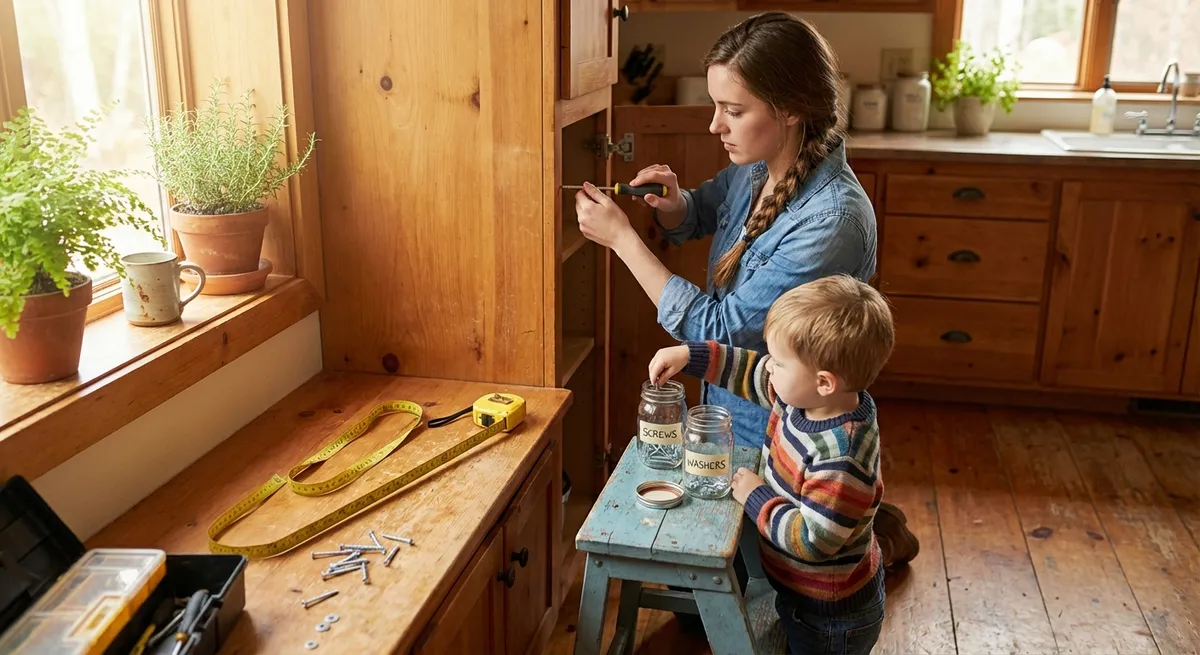
Below are five practical DIY tips anyone can follow, even if you’re starting from zero. Each one includes simple steps, clear tools, and what to watch out for—so you’re never guessing.
Tip 1: Build a Tiny Tool Kit That Actually Covers Most Jobs
Before you start fixing things, you’ll want a small set of basic tools you can grab quickly. You don’t need the giant 200-piece set—just a solid, everyday kit that covers most simple repairs and projects.
What you’ll want in your starter kit:
- Phillips screwdriver (cross-shaped tip)
- Flat-head screwdriver
- Adjustable wrench
- Tape measure (at least 16 feet)
- Utility knife (with extra blades)
- Hammer (a simple claw hammer is ideal)
- Pliers (needle-nose or combination pliers)
- Level (a small torpedo level is enough for most projects)
How to put your kit together:
- Check what you already own. Gather any scattered tools in drawers, closets, or boxes. You may only need to buy 2–3 items.
- Buy basics, not gimmicks. Choose solid, mid-priced tools—skip the super-cheap sets with dozens of tiny, fragile pieces.
- Keep everything in one place. A small toolbox, sturdy tote, or even a labeled shoebox works if that’s what you have. The key is knowing where everything is.
- Add as you go. When a project needs something new (like a stud finder or wood glue), buy it only when you actually need it.
Encouragement: A tiny, reliable tool kit turns “I’ll fix that later” into “I can do this right now.” That alone is a huge DIY win.
Tip 2: Master the Art of Hanging Things Straight (Without Stress)
Hanging pictures, shelves, or hooks is one of the most common—and frustrating—home tasks. The good news: once you know a simple process, it becomes quick and repeatable.
You’ll need:
- Tape measure
- Pencil
- Level
- Appropriate wall anchors or screws
- Screwdriver or drill (optional but helpful)
Step-by-step for hanging a picture:
- Find the right height. A common guideline: the center of the artwork should be around eye level (about 57–60 inches from the floor). Adjust if you’re hanging over furniture.
- Mark the center. Measure the width of your wall space, mark the center lightly with a pencil.
- Measure the hanging point. On the back of the picture, measure from the top of the frame down to the hanging hardware (wire or brackets).
- Transfer that measurement to the wall. From your wall’s center mark, measure down the same distance you just measured on the frame and make a small mark. That’s where your nail or screw will go.
- Use a level. If your piece has two hooks, use the level to ensure your marks are perfectly horizontal before drilling or nailing.
- Choose the right fastener.
- Light items (small frames): nail or small screw is usually fine.
- Heavier items: use wall anchors if you’re not screwing into a stud.
- Hang and adjust. Step back, check from a few angles, and nudge slightly if needed. Light frames can be adjusted just by gently shifting them on the nail.
Encouragement: After doing this process two or three times, you’ll stop wondering “Will this be crooked?” and start saying “I’ve got this.”
Tip 3: Learn a Simple, Clean Way to Patch Small Wall Holes
Nail holes, small dings, and tiny wall scars make a room feel messier than it is. Patching them is an easy DIY skill that instantly makes your home look more polished.
You’ll need:
- Lightweight spackle or wall filler
- Putty knife or old plastic card (like an expired gift card)
- Damp cloth or sponge
- Fine-grit sandpaper (optional)
- Touch-up paint (if available)
How to repair small nail holes and dings:
- Clean the area. Wipe away dust or loose paint with a dry cloth.
- Apply spackle. Use your putty knife (or card) to press a small amount of spackle into the hole. Fill it slightly above the surface.
- Smooth it out. Scrape off excess so the patch is almost flush with the wall. Don’t worry if it’s not perfect.
- Wipe gently. Lightly wipe around the patch with a damp cloth to feather the edges and remove extra material.
- Let it dry. Follow the product instructions—most lightweight fillers dry within 30–60 minutes for small holes.
- Sand if needed. If the patch feels rough or bumpy, lightly sand with fine-grit sandpaper until smooth.
- Touch up with paint. If you have leftover wall paint, dab it on with a small brush or sponge.
Encouragement: Start with one wall or one small area. Once you see how quick this is, you’ll spot “future wins” all over your home.
Tip 4: Change a Showerhead for an Instant Bathroom Upgrade
Swapping an old, low-pressure, or grimy showerhead for a new one is surprisingly easy and can make your bathroom feel completely different—no renovation required.
You’ll need:
- New showerhead (check that it’s compatible with your existing arm)
- Adjustable wrench or pliers
- Old towel or rag
- Plumber’s tape (Teflon tape)
Step-by-step:
- Turn off the water at the shower control. No need to shut off the main water—just make sure the faucet is off.
- Remove the old showerhead.
- Wrap the old showerhead connection with a rag (to avoid scratching), then loosen it with the wrench or pliers by turning counterclockwise.
- Many newer heads can be loosened by hand.
- Clean the threads. Wipe the shower arm threads (the part sticking out of the wall) with a cloth to remove old tape or mineral buildup.
- Apply plumber’s tape. Wrap the threads 2–3 times with Teflon tape, pressing it gently into the grooves. This helps prevent leaks.
- Attach the new showerhead.
- Screw it on by hand, turning clockwise until snug.
- If needed, give a final gentle turn with the wrench (use a rag to protect the finish). Don’t overtighten.
- Test for leaks. Turn on the water. If you see drips around the connection, gently tighten a bit more.
Encouragement: This entire job often takes under 15 minutes and gives you a “wow” upgrade every single morning.
Tip 5: Create a Simple “Fix-It” Routine So Stuff Actually Gets Done
Knowing a few DIY skills is helpful—but having a simple routine is what keeps your home from slowly falling apart. You don’t need a complicated system. A tiny, consistent habit is enough.
Try this simple fix-it routine:
- Keep a “home to-do” note somewhere visible.
- A sticky note on the fridge, a note on your phone, or a whiteboard works well.
- Whenever you notice something (loose knob, flickering bulb, tiny leak), write it down immediately.
- Pick one small task per week.
- Choose something that takes under 30 minutes.
- Examples: tighten a cabinet handle, patch two nail holes, replace a burnt-out bulb, organize your tool kit.
- Set a recurring time.
- Maybe Sunday afternoon, Friday evening, or a specific weeknight.
- Protect that 20–30 minutes like an appointment with your future, less-stressed self.
- Gather tools before you start.
- Look at your to-do item, grab what you’ll need (tool kit, cleaner, light bulb, etc.) before you begin.
- Celebrate the finish.
- Take a quick “before and after” photo.
- Cross it off your list. Noticing that sense of completion makes you more likely to keep going.
Encouragement: One tiny fix per week adds up to 52 improvements a year. That’s how homes quietly transform without ever needing a massive “project weekend.”
Conclusion
DIY doesn’t have to mean building furniture from scratch or rewiring your whole house. It can be as simple as hanging art straight, patching a little wall damage, or upgrading a showerhead. Each small success builds your skill, your confidence, and your comfort at home.
Start with one tip from this list—whichever feels easiest. Gather your tools, follow the steps, and give yourself credit when you’re done. That’s how you go from “I’m not handy” to “I can handle this,” one small project at a time.
Sources
- Lowe’s: Basic Hand Tools List - Overview of essential beginner tools and what they’re used for
- Family Handyman: How to Hang Pictures Like a Pro - Detailed tips on hanging artwork level and securely
- Behr: How to Patch and Repair Drywall - Step-by-step guidance for fixing small wall holes and imperfections
- The Home Depot: How to Replace a Showerhead - Visual and written instructions for changing a showerhead safely
- U.S. Department of Energy: Home Maintenance Checklist - Helpful reference for creating a regular home maintenance routine