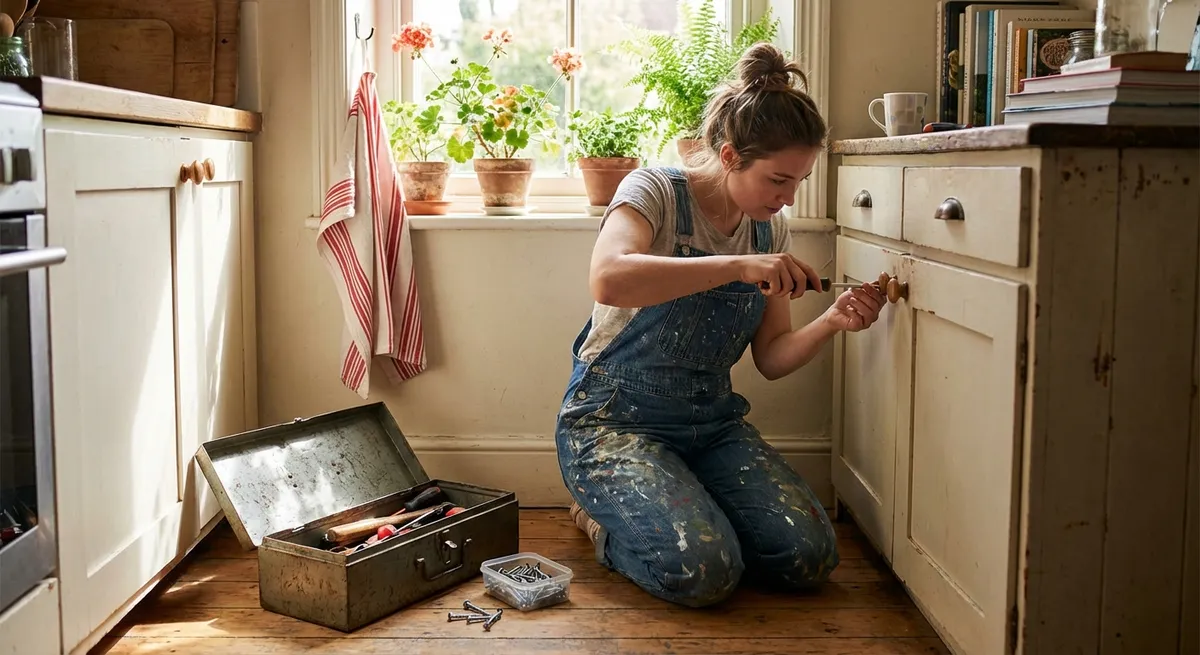
Tip 1: Silence That Squeaky Door or Cabinet
That squeak you hear every time you open a door? You don’t have to live with it. Lubricating hinges is fast, inexpensive, and instantly satisfying.
What you’ll need:
- Lubricant (silicone spray, WD‑40, or petroleum jelly)
- Rag or paper towel
- Optional: small flathead screwdriver or butter knife
Step-by-step:
- Identify the noisy hinge. Open and close the door or cabinet to find the exact hinge that’s squeaking.
- Protect surrounding surfaces. Place a rag or paper towel under the hinge to catch drips.
- Apply lubricant.
- For spray: Insert the straw (if it has one) and give a short burst directly onto the hinge pin and moving parts.
- For petroleum jelly: Use your finger or a cotton swab to rub a small amount into the hinge.
- Work it in. Open and close the door several times so the lubricant spreads inside the hinge.
- Wipe excess. Use a rag to remove any drips so dust doesn’t stick later.
- Reapply if needed. If the squeak is still there, add a little more and repeat.
This tiny fix makes your home feel quieter and better cared for—without any tools beyond what you probably already have.
Tip 2: Stop a Wobbly Chair or Table from Rocking
A wobbly chair or side table can make every meal, work session, or cup of coffee feel off-balance. With a few minutes and some simple materials, you can stabilize it and stop the rocking.
What you’ll need:
- Felt pads, furniture glides, or cardboard shims
- Scissors (if trimming felt or cardboard)
- Optional: wood glue (for loose joints)
Step-by-step:
- Find the problem leg. Place the chair or table on a flat surface. Gently rock it to see which leg isn’t touching the floor.
- Test a temporary shim. Fold a small piece of cardboard and slide it under the short leg. Rock the furniture again until it’s stable. This shows you how much thickness you need.
- Measure and cut. Cut a felt pad or cardboard piece roughly the size of the bottom of the short leg. Add layers if you need more thickness.
- Attach the pad.
- Peel-and-stick felt: Apply directly to the bottom of the short leg.
- Cardboard: Use double-sided tape or a small amount of glue.
- Check the stability. Set the furniture back down and test. Adjust thickness if it still rocks.
- Tighten joints if needed. If the wobble is from loose joints, flip the piece over and gently tighten screws or apply wood glue to visible loose joints, then let dry according to the glue instructions.
In a few minutes, you go from “careful, that’s wobbly” to “sit anywhere, it’s solid.”
Tip 3: Clear a Slow Drain Without Harsh Chemicals
A sink or shower that drains slowly is annoying—and it doesn’t mean you need to pour in harsh cleaners. With simple tools, you can often clear the clog safely and effectively.
What you’ll need:
- Baking soda
- White vinegar
- Kettle or pot for boiling water
- Optional: plastic drain snake or straightened wire hanger
- Rubber gloves
Step-by-step:
- Remove visible debris. Put on gloves. If your drain has a stopper or cover, remove it and pull out hair or gunk you can easily reach.
- Use a drain snake (if you have one). Insert the plastic snake or bent wire into the drain. Twist gently and pull out debris. Repeat a few times.
- Pour in baking soda. Add about ½ cup of baking soda directly into the drain. Try to get most of it down, not just around the rim.
- Add vinegar. Slowly pour in about 1 cup of white vinegar. It will fizz and bubble—that’s normal.
- Let it sit. Leave the mixture to work for 15–20 minutes. During this time, boil a kettle or pot of water.
- Flush with hot water. Carefully pour the hot (not scalding from the stovetop if you have PVC pipes—let it cool slightly) water down the drain to wash away loosened buildup.
- Test the drain. Run the tap or shower and see if the water flows faster. Repeat once if needed.
This gentle method helps maintain clearer drains and can reduce how often you need stronger measures.
Tip 4: Fix a Drafty Window or Door with Simple Weatherstripping
If you feel a cold breeze near a window or door, you’re likely losing comfort and money on heating or cooling. Quick, peel‑and‑stick weatherstripping can make a big impact in minutes.
What you’ll need:
- Adhesive foam or rubber weatherstripping
- Scissors or utility knife
- Mild cleaner and a cloth
- Optional: draft stopper or door sweep
Step-by-step:
- Find the drafts. On a windy day, run your hand slowly around the edges of doors and windows. You can also use a lit incense stick or candle (carefully) and watch where the smoke moves.
- Measure the gaps. Estimate how much weatherstripping you’ll need by measuring the top and sides of the frame.
- Clean the surface. Wipe down the door or window frame where you’ll apply the strip. Let it dry fully so the adhesive sticks.
- Cut to length. Cut a piece of weatherstripping to match one side of the frame.
- Peel and stick. Remove a small portion of the backing at a time, pressing the strip firmly along the frame as you go. Avoid stretching it; just lay it down gently and press.
- Repeat around the frame. Do the sides and top of the frame, then test by closing the door or window. It should close fully but feel slightly more snug.
- Add a bottom solution. For drafty doors, add a door sweep or fabric draft stopper along the bottom to block air from coming under the door.
You’ll feel the difference quickly, especially in colder or hotter months—and your energy bill may thank you, too.
Tip 5: Secure a Loose Towel Bar or Toilet Paper Holder
When a towel bar or toilet paper holder starts to wiggle, it usually means the screws are loose or the anchors in the wall are failing. Securing them properly can prevent a bigger repair later.
What you’ll need:
- Screwdriver (usually Phillips head)
- Wall anchors (if existing holes are stripped)
- Drill (optional but helpful for new anchor holes)
- Pencil
- Level (optional but useful)
Step-by-step:
- Check the mounting brackets. Gently pull on the bar or holder. Most fixtures have small set screws underneath; loosen them to remove the outer piece and expose the wall brackets.
- Tighten existing screws. Use your screwdriver to tighten the screws holding the bracket to the wall. If they tighten firmly and the bracket feels solid, reattach the fixture and you’re done.
- Inspect the holes. If the screws spin without tightening, the wall holes may be stripped or the anchors damaged. Remove the screws and old anchors, if present.
- Mark new holes. Hold the bracket against the wall in the same position. Use a pencil to mark where new screws should go, slightly offset from the old holes if possible.
- Install wall anchors.
- For drywall: Drill small pilot holes at your marks, then gently tap in plastic anchors until they’re flush with the wall.
- For tile: Use a masonry bit and drill slowly; consider using existing holes if drilling tile makes you nervous.
- Reattach brackets. Screw the brackets into the new anchors until snug and solid. Check with a level if you want it perfectly straight.
- Reinstall the fixture. Slide the towel bar or holder back onto the brackets and tighten the small set screws underneath.
Now your towels and toilet paper have a stable home—and your wall is better protected from future damage.
Conclusion
Quick fixes don’t require a workshop, fancy tools, or a full free weekend. When you tackle small, specific problems—like a squeak, wobble, draft, clog, or loose fixture—you build confidence and make your home feel calmer and more reliable, one simple project at a time. Pick just one of these tips and try it today. Each small success makes the next DIY task feel that much more doable.
Sources
- [U.S. Department of Energy – Air Sealing Your Home](https://www.energy.gov/energysaver/air-sealing-your-home) - Explains how sealing drafts around doors and windows improves comfort and efficiency
- [Family Handyman – How to Fix Squeaky Doors](https://www.familyhandyman.com/project/how-to-fix-a-squeaky-door/) - Step-by-step guidance on choosing and applying lubricants for hinges
- [Mayo Clinic – Household Chemical Safety](https://www.mayoclinic.org/healthy-lifestyle/adult-health/in-depth/hidden-home-hazards/art-20043940) - Overview of safety considerations when using chemical cleaners and why gentler methods can be beneficial
- [Energy Star (EPA) – Detecting Air Leaks](https://www.energystar.gov/campaign/seal_insulate/air_leaks) - Practical advice on locating and sealing common household air leaks
- [This Old House – Clearing Clogged Drains](https://www.thisoldhouse.com/plumbing/21015196/how-to-clear-any-clogged-drain) - Demonstrates safe, DIY methods for unclogging household drains without damaging pipes